
Choosing the right material is one of the most common questions parents ask. When selecting products for babies, colour and pattern are not the only things that matter. It is equally important to consider how soft, breathable and durable the fabric is, and how it performs in everyday use.
Organic cotton was once seen as a symbol of a more responsible approach to textile production. Today, it is perhaps discussed less often, and some customers may see it as little more than ordinary cotton with an “organic” label. However, the difference is not only in the name.
Organic cotton comes from the same plant as conventionally grown cotton. The main difference lies in the way it is cultivated, how its origin is controlled and the rules that apply to its further processing.
At Kaarsgaren, we do not usually buy ready-made organic cotton fabrics. Instead, we have our own knitted fabrics produced in the Czech Republic from GOTS-certified yarn. This allows us to influence the properties of the material and create original patterns designed especially for our products.
What is organic cotton?
Organic cotton is not a special variety of cotton plant. It is cotton grown according to the principles of organic agriculture.
Its cultivation is subject to stricter rules than conventional cotton production. The focus is placed on soil care, more natural methods of protecting the plants and the controlled origin of the raw material.
However, the term “organic cotton” alone does not tell us everything about the finished fabric. Many additional stages take place between the harvested cotton and the final product:
- cleaning and processing the fibres,
- spinning the yarn,
- knitting or weaving the fabric,
- dyeing or printing,
- finishing the material,
- sewing the finished product.
This is why it is important to consider not only where the cotton comes from, but also how it is processed afterwards.
How is organic cotton made?
After harvesting, the cotton fibres are separated from the seeds and other parts of the plant. They are then cleaned, aligned and spun into yarn.
The yarn is then used to produce fabric. Depending on the desired properties of the finished material, the fabric may be woven or knitted.
For our products, we mainly use knitted fabric. Compared with traditional woven fabric, it is usually more flexible, softer and better able to adapt to movement. This makes it particularly suitable for sleeping bags, fitted sheets, clothing and products that remain in prolonged contact with a baby’s skin.
The final properties of organic cotton are not determined by the fibre alone. They also depend on:
- the fineness and quality of the yarn,
- the density of the knitted fabric,
- the weight of the material,
- the method of dyeing or printing,
- the final treatment of the fabric.
Two fabrics labelled as organic cotton may therefore look and feel quite different.
What does GOTS certification mean?
GOTS stands for Global Organic Textile Standard. It is one of the best-known standards for textiles made from organically grown natural fibres.
It does not focus only on whether the cotton was grown using organic farming methods. It also covers additional stages of the textile supply chain and sets requirements for areas such as:
- the origin and traceability of the fibres,
- separating certified materials from conventional production,
- permitted and prohibited chemical substances,
- dyeing, printing and other treatments,
- wastewater treatment,
- working and social conditions in production.
You may come across the labels organic and made with organic materials. These differ according to the proportion of certified organic fibres contained in the product.
It is also important to distinguish between a certified raw material and a certified finished product. We use yarn certified according to the GOTS standard. However, this does not automatically mean that every finished product may carry full GOTS certification. For that to be possible, the other stages of the production chain must also be certified and controlled according to the standard’s requirements.
We consider this distinction important because we want to describe the origin of our materials accurately and without oversimplified claims.
What are the properties of organic cotton?
Organic cotton has the basic properties of a high-quality natural cotton material. However, the feel and performance of a particular fabric always depend on the way the yarn is processed and on the construction of the finished knitted fabric.
It feels pleasant against the skin
High-quality cotton knit is soft and comfortable when in contact with the skin. This is why it is often used for children’s clothing, sleeping bags, fitted sheets and blankets.
Softness does not depend on the organic label alone. The quality of the yarn, the density of the knit and the final treatment of the fabric also play an important role.
It is breathable
Cotton fibres allow air to pass through and can absorb moisture. Organic cotton is therefore suitable for products used throughout the year.
However, thermal comfort also depends on the weight of the fabric, the number of layers and any additional filling. A thin organic cotton fitted sheet will behave differently from a multi-layer baby blanket or an insulated sleeping bag.
It absorbs moisture well
Cotton can absorb moisture from the skin. However, once it becomes significantly damp, it dries more slowly than some synthetic materials or, for example, merino wool.
It is therefore always important to choose a product according to its intended use, the temperature and the number of layers.
It is suitable for everyday use
Organic cotton products are usually easy to care for and, when the washing instructions are followed, cope well with regular everyday use.
As with other natural fibres, slight shrinkage may occur during the first washes. This natural property needs to be taken into account during the design and cutting of the product.
Why does organic cotton not always look exactly the same?
We believe that these small differences are one of the advantages of natural materials.
Cotton fibre is not created in a factory according to an identical technical specification. It grows on a plant, and its characteristics may be influenced by the conditions during cultivation, harvesting and subsequent processing.
The yarn may therefore not be completely identical in every production batch. Sometimes the fibre is slightly thicker, while at other times it is finer. The surface of the knitted fabric may feel smoother or have a more noticeable natural texture.
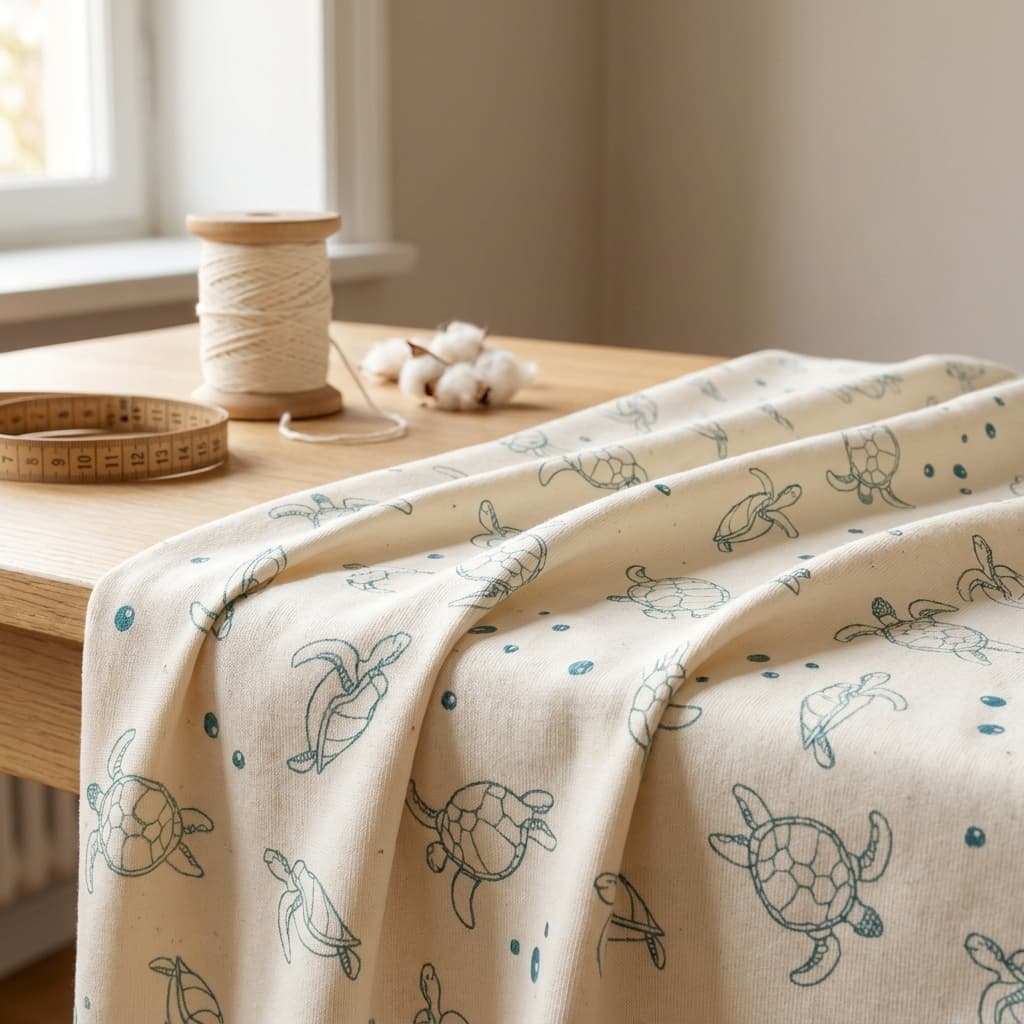
You may also notice tiny darker specks or small traces of plant material in the fabric. These are not dirt or a defect. They are a natural reminder of the origin of the cotton fibre.
The shades of individual production batches may also differ slightly. The final colour is influenced not only by dyeing or printing, but also by the natural shade of the original fibre.
In conventional materials, similar differences can be reduced through more intensive chemical processing. In a more naturally processed material, however, its original character may remain more visible.
Organic cotton may therefore not always be perfectly smooth, completely uniform in colour or visually “spotless”. We see this as a reminder that we are working with a genuine natural fibre rather than a synthetically manufactured material.
We are familiar with similar subtle variations in merino wool. Nature does not create every fibre in exactly the same way — and that is precisely where its beauty lies.
🧵 Our experience with organic cotton production
We do not simply select ready-printed organic cotton from a foreign supplier’s catalogue. Instead, we have it produced especially for us in the Czech Republic.
The process begins with the selection of yarn certified according to the GOTS standard. A Czech knitting mill then uses it to produce a knitted fabric with the properties we need for our products.
We also design our own patterns for selected collections. A new design therefore begins long before we start cutting the fabric. It involves creating the motif, choosing the colours, preparing the print and testing how the pattern will look on the finished knitted material.
Having our own knitted fabric produced allows us to influence:
- its softness,
- its flexibility,
- the weight of the fabric,
- its appearance,
- its suitability for a particular type of product.
This approach is more demanding than buying a commonly available ready-made fabric. On the other hand, it enables us to create materials and patterns that reflect our ideas and are different from those offered by many other manufacturers.
Keeping a larger part of the production process within Europe is also important to us. Cotton cannot, of course, be grown in the Czech Republic, but instead of importing finished printed fabrics over long distances, we purchase the yarn and have our own knitted fabric produced locally.
Without precise calculations, we do not want to claim that this method is automatically the most environmentally friendly option. However, it makes sense to us to produce as much of the material and the finished product locally as possible, to understand how it is made and to support Czech textile production.
How should organic cotton be washed?
Caring for organic cotton is not complicated. However, you should always follow the instructions provided with the specific product, as products differ in their construction, print, number of layers and any additional materials used.
As a general guide, we recommend:
- washing at the temperature stated on the care label,
- using a standard gentle laundry detergent,
- avoiding unnecessarily large amounts of detergent,
- not overloading the washing machine,
- reshaping the product after washing,
- drying it according to the instructions on the label.
Cotton may change slightly in size during the first wash. This is a natural characteristic of cotton fibre and is not unique to organic cotton.
Turning printed products inside out before washing helps protect the design from unnecessary mechanical rubbing.
Fabric softener is usually unnecessary. It may leave a coating on the fibres and, in some products, reduce their ability to absorb moisture.
Common myths about organic cotton
Organic cotton is only a marketing term
It is not. The term refers to the way the cotton is grown and, in the case of certified materials, also to the control of its origin and processing.
However, it is sensible to check exactly what a manufacturer means by the word organic and whether the certification applies to the fibre, yarn, fabric or the entire finished product.
Organic cotton is always softer than conventional cotton
Not necessarily. Softness depends primarily on the quality and thickness of the yarn, the knitting method and the final treatment of the fabric.
Organic cotton can be exceptionally soft, but the organic label alone does not guarantee a particular feel.
Organic cotton must be perfectly smooth and free from specks
Quite the opposite. In a more naturally processed material, you may notice tiny traces of the plant, subtle colour variations or slight irregularities in the fibres.
These are not automatically signs of lower quality. They are often a natural feature of a material that has not been treated to make it appear completely uniform.
Organic cotton is less durable than conventional cotton
Organic cultivation does not in itself make the finished fabric less durable. Its lifespan depends on the quality of the yarn, the construction and weight of the knit, the sewing and the way the product is cared for.
A high-quality organic cotton knit can serve well for many years.
Every organic cotton product is GOTS certified
It is not. A product may be made from organic cotton or from GOTS-certified yarn without the entire production chain and finished product being certified.
It is therefore worth paying attention to the precise wording used by the manufacturer.
Organic cotton is always environmentally friendly regardless of further processing
The organic origin of the fibres does not automatically solve every environmental impact associated with textile production. Energy and water consumption, dyeing, printing, transport, the lifespan of the product and the conditions in which it is made all matter too.
Organic cotton is an important step, but it is always useful to consider the whole story of a product.
👨👩👧 How to choose an organic cotton product
First consider what the product will be used for. The same material can behave differently depending on its weight, cut and number of layers.
For everyday sleep
Organic cotton sleeping sacks are soft, breathable and suitable for parents looking for an easy-care material for regular use.
Always choose the sleeping sack according to its TOG rating, the room temperature and the clothing worn underneath.
For the baby’s cot
Flexible organic cotton baby sheets adapt well to the mattress and feel pleasant against the skin.
For covering and resting
Baby blankets with organic cotton are suitable for everyday use at home and while travelling. Depending on the combination of materials and number of layers, you can choose a lighter or warmer version.
For warm summer days
Lightweight summer baby wraps made with organic cotton are a pleasant choice for warmer weather. The number of layers should always be adapted to the actual temperature and the baby’s needs.
For active children
We also use flexible organic cotton knit for anti-slip pants and children’s gloves, where the material needs to adapt comfortably to movement.
Frequently asked questions about organic cotton
Is organic cotton suitable for babies?
Yes. A high-quality organic cotton knit is soft, breathable and comfortable against the skin. However, the suitability of a particular product also depends on its construction, the other materials used and choosing the correct size.
Is organic cotton hypoallergenic?
The organic label alone cannot guarantee that a material will never cause an allergic reaction. However, organic cotton is popular for baby products because of its softness and controlled method of cultivation and processing.
For a child with a diagnosed allergy or significant skin problems, it is advisable to discuss the choice of material with a doctor.
Is organic cotton suitable for summer?
Yes. Lightweight organic cotton knits are breathable and absorb moisture well. However, thermal comfort also depends on the weight of the fabric, the number of layers and the construction of the particular product.
Is organic cotton suitable for winter?
Yes, although cotton itself is not a highly insulating material. For winter products, it is therefore often combined with another layer, such as merino wool, warm fleece or an insulating filling.
Why are there tiny specks in the fabric?
They may be small traces of the plant from which the cotton fibre comes. Such specks are common in more naturally processed materials and do not automatically indicate a defect.
Why does a new production batch have a slightly different shade?
Natural fibres do not always have exactly the same original colour or structure. The final shade may also be influenced by the individual dyeing or printing batch. Slight variations are therefore a natural characteristic of the material.
How can I recognise genuine organic cotton?
Look for specific information about the origin of the material and its certification. General claims such as “natural” or “responsibly made” do not necessarily mean that the cotton is certified organic.
Does using GOTS-certified yarn mean the entire product is GOTS certified?
Not automatically. Yarn certification confirms the origin and processing of that particular raw material. For the finished product to be labelled as GOTS certified, the other stages of production must also meet the specified requirements.
Is organic cotton better than conventional cotton?
In terms of cultivation methods and control over the origin of the fibre, organic cotton offers important advantages. However, it cannot be said that every organic cotton product is automatically of higher quality than every product made from conventional cotton.
The final quality also depends on the yarn, the construction of the fabric, the finishing process and the way the product is sewn.
A natural material does not have to be perfectly uniform
We have become accustomed to expecting natural materials to have the same regularity as industrially produced synthetic fibres. Cotton, however, grows on a plant. Each fibre may therefore differ slightly in thickness, colour and surface.
These small differences remind us where the material comes from.
We do not love organic cotton despite its natural irregularities. We love it partly because of them.
Nature is not perfectly uniform. And that is precisely where its beauty lies.
Kaarsgaren Material Guide
Every material has its own unique properties and is best suited for a particular purpose. That is why we have created a series of articles that explain what our products are made of, what makes each material special and which products it is best suited for.
| Material | Article |
|---|---|
| Terry cotton | ➜ Read more |
| Muslin | ➜ Read more |
| Bamboo viscose | ➜ Read more |
| Tencel™ (Lyocell) | ➜ Read more |
| Merino wool | ➜ Read more |
| Cotton | ➜ Read more |
| Polyurethane membrane | ➜ Read more |
Our goal is not to claim that there is one perfect material for every situation. Each material has its own strengths and is suitable for different products and different needs. We believe that understanding their properties will help you choose the right product more easily.


