
Choosing the right fabric is one of the most common questions parents ask. Muslin, bamboo viscose, merino wool or organic cotton – each material has unique properties and is suited to different situations. In our blog series, we introduce each of them to help you choose the one that best fits your child's needs.
Today we're looking at one of the most misunderstood natural fibres – merino wool. Some people believe it feels itchy, while others think it's only suitable for winter. In reality, neither is entirely true.
At Kaarsgaren, we've been making merino products for more than twenty years. During that time, we've worked with thousands of metres of fine merino knit fabric, creating sleeping bags, blankets, stroller liners, hand muffs and many other products for babies and young children. In this article, we'll not only explain how merino wool works but also share the practical experience we've gained over the years.
What Is Merino Wool?
Merino wool comes from Merino sheep, a breed known for producing exceptionally fine and soft wool. Today, most high-quality merino wool used in textiles originates from Australia and New Zealand.
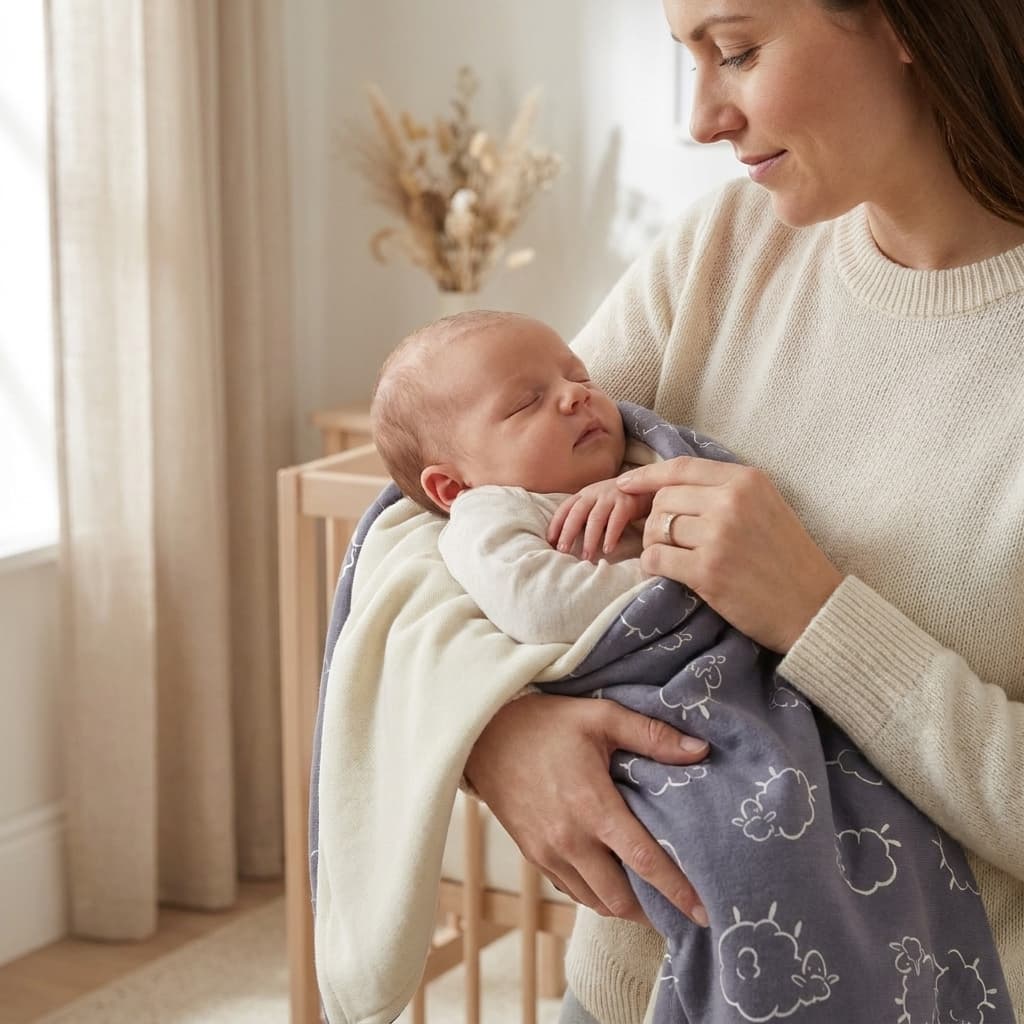
Unlike traditional wool, merino fibres are much finer. This makes the fabric remarkably soft, flexible and comfortable, even when worn directly against the skin.
How Is Merino Different from Regular Wool?
When many people hear the word "wool", they imagine thick, scratchy sweaters that feel uncomfortable against the skin. Modern merino wool is completely different.
The biggest difference lies in the diameter of each individual fibre. The finer the fibres, the softer and more comfortable the fabric feels. That's why merino wool is widely used not only for outdoor clothing but also for products designed specifically for newborns and babies.
What Does 18.5 Microns Mean?
The fineness of merino wool is measured in microns (µm). One micron equals one thousandth of a millimetre.
For our merino sleeping bags, we use an exceptionally fine merino knit measuring 18.5 microns. Fibres this fine feel incredibly soft, adapt naturally to your baby's movements and are gentle even on delicate newborn skin.
However, not all merino wool is the same. Different fabrics vary in fibre construction, weight and intended use. That's why we choose one type of merino for sleeping bags, another for stroller and car seat liners, and a different one for winter footmuffs, hand muffs and anti-slip blankets. Later in this article, we'll explain why each product requires a different type of merino.
Why Is Merino Wool Considered a High-Performance Natural Fibre?
When people think of high-performance fabrics, they often picture synthetic sportswear. Yet one of nature's best-performing fibres is actually merino wool.
Merino helps create a comfortable microclimate around the body. It can absorb moisture vapour produced by perspiration, move it away from the skin and gradually release it into the surrounding air. This helps keep the wearer comfortable across a wide range of temperatures.
That's why merino wool is trusted not only by parents of young children but also by hikers, cyclists, runners and outdoor enthusiasts who need reliable comfort in changing conditions.
Is Merino Wool Only for Winter?
Absolutely not. In fact, this is one of the biggest misconceptions about merino wool.
Merino doesn't simply "make you warm". Instead, it helps your body maintain a comfortable and balanced temperature. That's why it's popular not only in winter but also throughout spring, autumn and even during summer.
In warm weather, merino's breathability and excellent moisture management help keep the wearer comfortable during everyday activities as well as outdoor adventures. Many athletes choose merino base layers even in summer for exactly this reason.
You may also read that merino wool provides a degree of natural UV protection. While this is true, the actual level depends on factors such as the fabric's weight, density, colour and construction. Therefore, merino should not be considered a replacement for clothing with laboratory-tested UPF ratings.
Lanolin – Nature's Protective Wax
One of merino wool's natural components is lanolin, often called wool wax. It protects the sheep's fleece from moisture and dirt, and some of these natural properties remain in the finished fabric.
Thanks to lanolin, merino products often don't need washing after every use. In many cases, simply airing them outdoors is enough to refresh them.
🧵 Our Experience from More Than 20 Years of Manufacturing
After working with merino wool for more than two decades, one thing still surprises us every time we open a new roll of fine merino knit fabric – just how incredibly soft it feels.
It may sound a little unusual, but everyone in our workshop does the same thing. We instinctively run a hand across the fabric before cutting it. It's wonderfully soft, pleasant to touch and simply enjoyable to work with. Moments later, that same fabric begins its journey to becoming a sleeping bag, blanket or stroller liner for another little customer.
People often say that wool is itchy. Our experience has been very different. High-quality fine merino wool is exceptionally soft, which is exactly why we trust it for products made for babies from their very first days.
Why Do We Use Different Types of Merino Wool?
Many people are surprised to learn that there isn't just one type of merino wool. Different products require different levels of softness, warmth, durability and structure, which is why we use several types of merino fabrics.
For our sleeping bags, we use an exceptionally fine 18.5-micron merino knit. It's incredibly soft and comfortable, making it ideal for direct contact with a baby's delicate skin.
For stroller and car seat liners, we choose a heavier merino knit with a higher fabric weight. This provides greater durability, holds its shape better and offers extra comfort during outdoor walks.
For winter footmuffs, hand muffs, gloves and our anti-slip blankets, we use merino fleece (a soft merino pile bonded to a cotton backing). This creates a warm, cosy layer that's perfect for cold weather.
Each of these materials has its own strengths. Rather than using the same fabric for everything, we carefully select the type of merino that best suits each product and how it will be used.
🧶 Why Can Some People Smell Sheep?
This is a question we receive only occasionally, but it's worth explaining.
Merino wool naturally contains lanolin, often called wool wax. Most people don't notice its scent at all. Others describe it as the natural smell of wool or the outdoors, while a small number of people may associate it with sheep.
In more than twenty years of manufacturing, we've only had two customers who told us they didn't like the natural scent of merino wool. It is genuinely rare, but just as people experience the smell of leather or wood differently, everyone perceives natural wool in their own way.
One customer's comment actually led us to an interesting discovery. She told us that our merino sleeping bag reminded her of her grandmother's permanent wave. Curious, we looked into it and found that lanolin was once commonly used in hair-care products, including solutions for permanent waves, to help protect the hair. Suddenly, her description made perfect sense.
Common Myths About Merino Wool
❌ Merino wool is only for winter.
Not true. Thanks to its natural temperature-regulating properties, merino wool is comfortable throughout the year. That's why it's popular with parents, hikers, runners and outdoor enthusiasts alike.
❌ All merino wool feels itchy.
Not true. The softness depends largely on the diameter of the fibres. High-quality fine merino is exceptionally soft, which is why it's widely used for newborn and baby products.
❌ Merino wool needs washing after every use.
Not at all. In many cases, simply airing the product outside is enough to refresh it. Merino's natural properties mean it usually requires less frequent washing than many other fabrics.
❌ All merino wool is the same.
Definitely not. Merino fabrics differ in fibre fineness, weight, construction and intended use. Choosing the right type of merino is just as important as choosing the right product.
How Should You Wash Merino Wool?
Looking after merino wool is easier than many people think, but there are a few important rules worth following.
The biggest enemy of merino isn't water—it's sudden temperature changes. Washing in water that's too hot, followed by a cold rinse, or exposing wet merino to excessive heat can cause the fibres to felt and shrink.
Always follow the care label and use a detergent designed specifically for wool.
We've covered this topic in much more detail in these guides:
Proper care will help your merino products last for many years. Even with the best care, however, you may eventually notice small pills appearing on the surface. This is completely normal for fine natural fibres.
Why Does Merino Wool Pill?
Another question we're often asked is about pilling. Seeing small fuzzy balls appear on the surface of a garment can be worrying, but in most cases, it's not a defect.
Pilling is a natural characteristic of fine fibres. It occurs in areas exposed to friction, such as where stroller harnesses, car seat straps or everyday movement rub against the fabric.
In fact, there's a simple reason for this. The finer and softer the fibres are, the more likely they are to develop some initial pilling. It's not a sign of poor quality—quite the opposite. It's a natural characteristic of exceptionally soft natural fibres. Once the loose surface fibres have worked free, pilling usually decreases significantly.
If pills do appear, they can easily be removed using a fabric shaver or a wool comb without damaging the fabric.
You can read more in our article Why Does Merino Wool Pill?.
👨👩👧 Choosing the Right Merino Product
| If you're looking for… | We recommend… |
|---|---|
| An all-season sleeping bag | Fine merino knit |
| A stroller or car seat liner | Heavier merino knit |
| A winter footmuff | Merino fleece |
| Hand muffs or gloves | Merino fleece |
| A blanket for your stroller | A double-sided merino blanket or an anti-slip merino blanket, depending on your needs |
Frequently Asked Questions
Is merino wool suitable for newborn babies?
Yes. Fine merino wool is widely used for products designed for babies from birth.
Can merino wool be used in summer?
Absolutely. Its natural temperature regulation and moisture management make it comfortable throughout the year.
Do I need to wash merino after every use?
No. In many cases, simply airing the product outside is enough to keep it fresh.
Why does merino wool sometimes smell like sheep?
That's due to lanolin, a natural wax found in wool. Most people never notice it, but those with a particularly sensitive sense of smell sometimes do.


